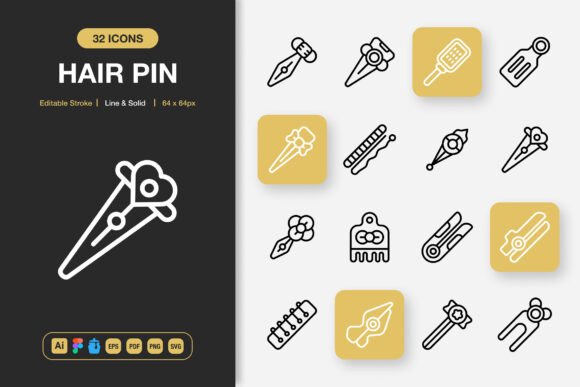
Hair Pin Icons as a Strategic Design Asset for Modern Creative Projects
Imagine you are deep into a UI design sprint for a beauty booking app. The deadline is tight, the wireframes are approved, but the visual layer still feels generic. You need interface elements that speak to hair salons, styling, and personal care without cluttering the screen. This is the moment a well-curated Hair Pin Icons set moves from a simple download to a critical component of your workflow. It is not just about having a picture of a hairpin; it is about having a cohesive, adaptable, and instantly usable visual language ready to drop into your project with zero friction.
High-quality icon sets like this one solve a specific, recurring pain point for designers, marketers, and entrepreneurs: the gap between needing a professional visual and the time it takes to create or source one from scratch. Whether you are building a website, laying out a product catalogue, or designing social media graphics for a hair product launch, the right icons eliminate guesswork. They allow you to maintain momentum because you are not stopping to adjust line weights, fix clashing styles, or hunt for matching solid and outlined versions across different folders.
Understanding the Value of a Purpose-Built Icon Collection
At its core, a set of Hair Pin Icons is a tool for visual communication. But unlike generic symbol packs, a dedicated set focuses on a clear theme. This thematic focus is what transforms it from a decorative afterthought into an integral part of your design system. When you plan a project—say an e-book on DIY hair care or an infographic about vintage hairstyles—the availability of consistent, on-topic icons allows you to structure content more clearly. You can map icons to chapter headings, illustrate step-by-step processes, or create visual anchors that guide the reader’s eye without text overload.
Many creative professionals know the frustration of mixing icons from multiple sources. Slight variations in stroke thickness, corner radius, or even the baseline grid can make a final composition look amateurish. A comprehensive set like this removes that risk from the start. Because the files include both line and solid styles with an editable stroke, you can blend them within a single project while keeping the entire interface or layout visually unified. The editable stroke feature is particularly important in UI work. If your brand guidelines use a specific stroke weight—say 1.5px instead of 2px—you can adjust every icon in seconds rather than redrawing paths. This keeps your project adaptable without sacrificing consistency.
Integrating Hair Pin Icons into Your Design Workflow
The way you bring an icon set into your process determines whether it becomes a time-saver or another file you never open. Start by reviewing the deliverables during the resource planning phase. This particular collection includes a source Adobe Illustrator file, a Figma file, an Iconjar file, EPS version 10, PDF, and SVG, plus PNGs in multiple sizes from 32px to 512px. That range is not just a list of formats—it is a map of how you can use the icons across different tools without converting a single thing.
- Figma file: Ideal for UI/UX designers who work inside collaborative environments. You can copy and paste icons directly into your component library, apply color overrides, and even prototype interactive states.
- Adobe Illustrator source file: Perfect for print and branding. You can extract individual vector shapes for logo development, packaging, or large-format posters where scalability matters.
- Iconjar file: A direct integration for teams that use this icon management tool. It lets you search, organize, and drag-and-drop icons into Sketch, Figma, or Adobe apps without leaving your artboard.
- SVG and PNG files: Cover web development, social media, and document-based projects. The PNG transparency at multiple sizes means you don’t need to resize and risk blurriness—32px for favicons, 256px for blog headers, 512px for high-res screens.
When you prepare a new project, import the relevant formats into your working directory. If you are building a mobile app, place the SVG folder inside your assets directory. For a book layout, link the EPS files in your InDesign document. This small organizing step prevents you from opening a dozen different applications later just to grab one icon. You maintain efficiency by letting the file structure mirror your project structure.
Where These Icons Shine in Real Projects
The versatility of Hair Pin Icons extends far beyond a single industry. Because they depict a recognizable object with cultural and aesthetic associations, they fit into a wide range of applications that touch on style, organization, personal care, and even metaphor (e.g., “hold things together,” “keep it in place”). Consider these common scenarios where the set provides immediate practical value:
Websites and Mobile Apps
For a salon booking platform, icons can represent service categories: a hairpin for updos, a comb for cuts, a curling iron for styling. Because the set includes both solid and line styles, you might use solid versions in the bottom navigation bar for high contrast and line versions in secondary menus or onboarding screens. The drag and drop nature of Figma or Iconjar means developers can swap styles without requesting new assets from the design team, smoothing the developer-designer handoff.
Social Media and Infographics
Beauty influencers, marketing teams, and social media managers need visual consistency across posts. The PNG files with transparency allow you to layer icons over photos or colored backgrounds without white boxes. When creating an infographic about historical hair trends, the editable stroke lets you recolor the icons to match your brand palette—warm gold for a luxury brand, soft pink for a teen-focused campaign. This customization keeps your content brand-aligned while the ready-made vectors save hours of illustration time.
Flyers, Banners, and Print Materials
EPS version 10 and PDF are print-friendly standards. A salon owner can open the EPS file in CorelDRAW or Illustrator, scale a hairpin icon to poster size without losing quality, and combine it with event details for a Mother’s Day promo. Because the source file is included, you can even deconstruct the icon to create a background pattern or a subtle watermark, options that would be impossible with a flat raster image.
Books and Educational Content
If you are self-publishing a guide to classic hairdressing techniques, the consistent style across all icons lets you use them as margin notes, chapter dividers, or part of a visual index. Assignment sheets, checklists, and step-by-step diagrams feel cohesive, which improves the reader’s learning experience. The readme.txt file included with the download often contains usage tips and licensing clarifications, which is helpful for freelance designers who need to confirm they can use the icons in commercial products without additional attribution.
Maximizing Efficiency with Organized Icon Assets
One of the quiet productivity killers in design work is asset chaos—files scattered across drives, inconsistent naming, duplicate copies of the same icon modified for different projects. To avoid this, treat your Hair Pin Icons as a master resource. Store the original download in a dedicated “icon library” folder, then create symbolic links or aliases into active project folders rather than copying the entire set each time. This centralization means any future updates from the creator can be applied once without breaking ongoing work.
During a project, you might need to share a specific icon with a team member who works in a different tool. Because the set includes SVG (a web standard) and PNGs in seven sizes, you can almost always find a compatible format. If a developer asks for a 48px icon for a mobile menu, you already have it. If a video editor needs a transparent PNG at 512px for an intro animation, it is there. You skip the back-and-forth resizing and re-exporting that typically eats up mornings.
The presence of a source file like Adobe Illustrator also allows for long-term adaptability. Perhaps six months from now, you redesign a brand identity and need a slightly thicker stroke or a different default corner style. Instead of searching for a replacement icon, you open the original AI file, adjust the stroke globally, and re-export all needed deliverables. This is quality control applied to visual assets—you future-proof your work against brand evolutions.
Customization and Consistency Across Platforms
A common mistake when using pre-made icons is treating them as final, untouchable images. The true power of this set lies in the editable stroke and the availability of line and solid variants. Use these features to create semantic distinctions in your interfaces. For example, solid hairpin icons could indicate a “favorited” style in a hair catalog, while line hairpin icons mark “available” options. This is a lightweight way to add interaction cues without adding new visual elements.
When you plan a multi-platform campaign—social media ads, a landing page, an email newsletter, and a printed voucher—maintain visual harmony by pulling the same icons but adapting them to each medium. The EPS for print, PNG for email (since many email clients still struggle with SVG), and SVG for the web. The high quality of the 512px PNG ensures that even when scaled down for mobile screens, the icon remains crisp. This cross-platform adaptability directly supports a cohesive brand experience without clunky workarounds.
For teams, the Iconjar integration is a small but meaningful addition. Non-designers—like social media coordinators or content writers—can use Iconjar to search for “hairpin” and drag the icon directly into a Canva design or a presentation slide. They don’t need to know what a vector is; they just get the correct asset. This reduces the bottleneck where designers become couriers for assets, freeing everyone to work faster.
Technical Details That Support Seamless Implementation
Let’s look at how the file specifications translate into a practical, no-surprises experience. The list of included files reads like a checklist for professional handoff: Source File Adobe Illustrator, Figma File, Iconjar File, EPS Version 10, PDF File, SVG File, PNG Transparency (32px, 48px, 64px, 96px, 128px, 256px, 512px), and a Readme.txt. Each fulfills a specific role in the production chain.
- Adobe Illustrator and EPS: Provide a single source of truth for print and advanced vector editing. EPS 10 ensures compatibility with legacy systems and older design software.
- Figma: Connects directly to modern, browser-based design workflows. You can open the file, select an icon, press Ctrl+C, and paste it into your project file—no file conversion dialog boxes.
- Iconjar: Supports the growing shift toward organized, searchable icon libraries, especially useful for teams managing hundreds of icon sets.
- PDF: Serves as a universal preview format for clients who don’t have design software. You can send a single PDF containing all icons for approval without exporting individual JPEGs.
- SVG and PNGs: Cover the full spectrum from web code to presentation software. The multiple PNG sizes mean you don’t have to open Photoshop just to get a 96px image for a Notion page or a 256px image for a Medium article.
The readme.txt file might seem minor, but it often contains licensing details, installation tips for Iconjar or Figma, and sometimes the creator’s contact information. Reading it early prevents legal questions later, especially if you are using the icons in a client project or a digital product you plan to sell.
From Planning to Publishing: A Real-World Integration Example
Let’s trace a realistic sequence to see how Hair Pin Icons fit into a complete project lifecycle. Suppose you are a freelance marketer tasked with creating a lead magnet—a PDF lookbook of updos for a bridal hair stylist. In the planning stage, you brainstorm the sections: updo types, face shape recommendations, accessory pairings, and a FAQ. You decide early that each section heading will feature an icon to create a premium, magazine-like feel.
During the design phase, you open the Figma file and pull the line-style hairpin icon for the headings. You adjust the stroke color to match the stylist’s brand—a soft champagne that contrasts well against the blush background. For the accessory page, you use a solid hairpin icon placeholder until the client provides product photos. The consistency between the line and solid icons means you don’t have to test alignment; they naturally sit on the same visual baseline. You export the final PDF using the high-resolution PNGs to avoid any vector rendering issues in the client’s PDF reader.
Later, the stylist asks for social media teasers. You reuse the same icons from the EPS file, enlarging them to 512px and placing them over stylized photos of hair buns. The result is a campaign where the lookbook and the Instagram stories feel like one continuous brand experience. The long-term use value is clear: months later, when the stylist needs a blog post graphic about hairpins for curly hair, you can simply pick up the icon set and create a new visual in minutes because the asset is already organized and consistent.
Making the Set Part of Your Standard Toolkit
Adopting a new asset into your routine requires more than a download. Take ten minutes to set up a local preview system. Open the Iconjar file and drag the library into your toolbar, or import the Figma file as a component library so it appears in every new project. This small upfront organization step means that the next time you need an icon, you won’t have to navigate to a buried folder; the set will be right there among your go-to resources.
If you work with others, share the location of the master icon files in your team’s documentation. Include a note about the editable stroke feature so that developers and product managers understand they can request stroke adjustments without requesting a brand new icon. This simple communication turns a static set into a dynamic system that supports iterative design.
Ultimately, Hair Pin Icons are more than a collection of pretty symbols. They are a bridge between the initial concept and the final polished output. By offering both line and solid styles, editable strokes, and an exhaustive range of file types, the set removes recurring friction points from the creative process. You spend less time solving icon-related problems and more time refining the message, the layout, and the user experience—exactly where your attention belongs.