Fertilizer Icons for Modern Design Projects
Every visual project starts with small decisions that shape how people perceive your work. A set of well-crafted Fertilizer Icons might seem like a niche resource, but the right icon collection can quietly elevate websites, mobile apps, educational materials, and printed media. This particular icon set brings together agricultural and gardening imagery with a clean, minimalist design language that suits far more than farming-related content. Whether you are updating a gardening blog, building an eco-brand, or designing packaging for organic products, these icons offer a consistent visual vocabulary that feels professional without becoming stiff or overly corporate.
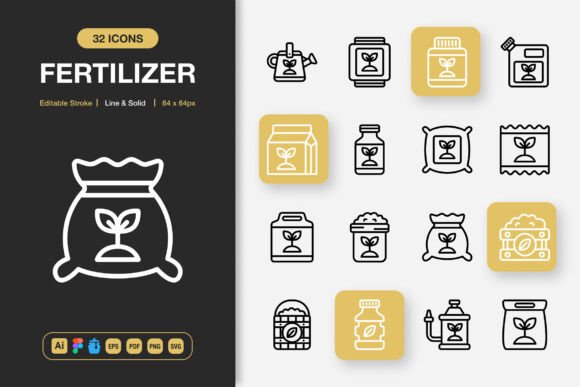
What makes a collection like this stand out is not just the subject matter but the way it has been assembled with versatility in mind. The Fertilizer Icons pack includes both line and solid style variants, so you can maintain visual harmony across different parts of a project without switching between mismatched icon families. The editable stroke feature gives you control over line weight, making it possible to adapt each icon to your existing design system rather than forcing your layout to accommodate someone else's aesthetic choices.
What Are Fertilizer Icons and Who Benefits Most
At their core, Fertilizer Icons are a curated collection of vector graphics depicting elements related to soil nutrition, plant growth, and agricultural care. You will find representations of fertilizer bags, granules, spreaders, soil amendments, composting symbols, and nutrient-related imagery. But describing them only by their subject matter undersells their practical value. These icons function as communication shortcuts. A small graphic of a fertilizer sack next to a product description tells a shopper what they are looking at faster than a paragraph of text ever could.
Different people come to an icon set with different expectations. A small business owner selling organic fertilizers online may care most about how the icons render on a mobile product page. An educator building a presentation about soil health might prioritize clarity at large projection sizes. A UI designer working on a farm management app will scrutinize how the icons behave at tiny navigation sizes. A hobbyist gardener creating a printable planting guide probably values easy drag-and-drop placement above advanced customization. Understanding which priorities matter to you helps determine whether this specific collection fits your workflow.
Beginners and Hobbyists: Getting Started Without Overwhelm
If you are relatively new to design or simply want attractive visuals without spending hours tweaking settings, the straightforward file structure of this icon set will appeal to you. The Fertilizer Icons package includes PNG files at multiple resolutions—32px, 48px, 64px, 96px, 128px, 256px, and 512px—with transparency already applied. This means you can drag an icon directly into a Canva project, a Word document, a social media post template, or a simple website builder without needing specialized software. The PNG formats eliminate the learning curve that sometimes accompanies vector files.
For hobbyists creating gardening club flyers, seed swap event posters, or personal blog graphics, the pre-rendered PNGs provide immediate usability. You do not need to understand what an SVG is or how to open an Adobe Illustrator file. You simply pick the size closest to your needs and place it where you want it. The transparent background ensures the icon integrates cleanly with whatever backdrop you have already set up, whether that is a photo of your garden or a solid color block.
Experienced Designers: Vector Control and Total Customization
Professional designers tend to look beyond the PNG offerings and head straight for the source files. This collection delivers on that front with Adobe Illustrator files, an EPS version 10 file, SVG files, and a Figma file. Having multiple vector formats means you are not locked into a single application ecosystem. If your team works in Figma for collaborative interface design, you can pull the icons directly into your component library. If your print workflow relies on Illustrator, the AI files preserve layers and editable paths. The EPS format ensures compatibility with older software and with colleagues who may use CorelDRAW or other vector editors.
The editable stroke feature deserves particular attention. When an icon set offers editable strokes, you gain the ability to adjust line thickness independently from the overall icon size. This matters enormously when you need to match an existing brand style guide that specifies stroke weights for interface elements. A food delivery app with 2px line icons will look inconsistent if your agriculture section suddenly introduces 4px strokes. With this collection, you can unify the appearance without redrawing anything from scratch.
Educators and Content Creators: Clarity and Visual Consistency
Teachers, trainers, and content creators often work across multiple formats simultaneously. The same lesson about composting might need graphics for a downloadable PDF worksheet, an Instagram carousel, a YouTube thumbnail, and slides projected in a classroom. Maintaining visual consistency across all these touchpoints builds trust and reduces cognitive load for learners. The Fertilizer Icons set supports this cross-format consistency because the same icons available as editable vectors for your presentation software also exist as high-resolution PNGs for your social media graphics.
The line and solid style variants add another layer of flexibility for educational materials. You might use line-style icons for worksheet diagrams where students need to see details clearly without heavy fills competing with text. The same icon in solid style could work better for a slide title where you want a bold, instantly recognizable symbol that grabs attention from the back of the room. Having both options within a single, cohesive family saves you from the jarring experience of mixing icons from different designers.
Practical Applications Across Project Types
The real strength of a well-built icon set reveals itself when you start placing the graphics into actual projects. Let us explore how different people might use the same Fertilizer Icons for remarkably different purposes, each extracting value based on their own goals and skill levels.
Website and mobile app interfaces benefit from the SVG and Figma files. A marketplace for agricultural supplies can use fertilizer bag icons as category indicators. A gardening tracker app might use nutrient-related symbols to label soil amendment reminders. The 100% customizable nature of the vectors means you can change colors to match your brand palette, adjust icon sizes to fit your grid system, and even combine elements to create new compound icons without leaving your design tool.
Print materials and packaging gain from the high-quality vector output that scales without pixelation. A small organic fertilizer company designing product labels needs icons that look crisp whether printed on a tiny sachet or a large display banner. The EPS and AI files guarantee that your print vendor receives artwork that meets professional prepress standards. Banners, posters, and flyers promoting gardening workshops or farm events can incorporate these icons as visual anchors that guide the reader through information hierarchies.
Social media and infographics thrive on scannable visual shorthand. An infographic explaining the nitrogen-phosphorus-potassium ratio becomes instantly more accessible when fertilizer icons reinforce the numerical data. Instagram posts about sustainable gardening practices gain visual appeal when minimalist icons frame your message without overwhelming your photography. The transparent PNGs at multiple sizes mean you can prepare assets quickly for different platform requirements—a 512px version for Pinterest and a smaller 64px version for a Twitter inline graphic.
Books, ebooks, and publications use icons to break up dense text and signal recurring themes. A gardening guidebook can place a consistent fertilizer icon next to every fertilizing tip throughout the manuscript. This visual cue helps readers skim for relevant sections and creates a polished, professionally designed interior layout. Publishers and self-publishing authors alike appreciate that the included PDF and SVG files integrate smoothly with both Adobe InDesign and Affinity Publisher workflows.
Choosing the Right Icon Set for Your Needs
Not every icon collection fits every person. Your evaluation should consider your typical project requirements, your comfort level with different file formats, and whether the licensing terms support your intended use. The Fertilizer Icons package includes an Iconjar file, which points toward thoughtful organization for designers who manage large icon libraries. Iconjar integration means you can search, filter, and drag icons directly from the Iconjar application into Sketch or other compatible design tools, speeding up your workflow considerably.
Think about whether you need depth or breadth from your icon set. If your project requires dozens of distinct fertilizer-related symbols covering different aspects of soil nutrition, composting, and plant care, a specialized collection serves you better than a general agriculture set that might include only two or three relevant icons. Specialization often saves you time because you are not forced to adapt generic icons to fit specific concepts.
Consider your collaboration environment as well. The Readme.txt file included in the package suggests that the creator has documented the contents and usage guidelines. For teams where multiple people will access and use the icons, having clear documentation reduces the back-and-forth questions about file locations, licensing, and technical specifications. The presence of both a Figma file and an Illustrator file indicates awareness that modern design teams often span multiple tools.
Quality Indicators That Matter Long-Term
High quality in an icon set reveals itself through attention to detail that might not be obvious at first glance. Consistent optical sizing across icons ensures that a fertilizer bag icon and a soil granule icon feel like they belong together even though their shapes differ. Properly constructed vector paths mean you can enlarge an icon for a billboard without discovering awkward curves or misaligned anchor points. Transparent PNGs at seven different resolutions suggest the creator understands that different platforms and use cases demand different output sizes, saving you the extra step of resizing icons yourself.
The dual style offering—line and solid—reflects a mature understanding of how icons function in real-world interfaces. Line icons often perform better in navigation menus and inline text scenarios where they need to coexist with typography without overwhelming it. Solid icons work better in call-to-action buttons, app launcher icons, and feature highlights where visual weight matters. Owning both styles within a single collection prevents the subtle but noticeable brand fragmentation that occurs when you source icons from multiple unrelated sets.
For those who plan to use these assets commercially, the customizable and editable nature of the vector files provides long-term flexibility that static PNGs alone cannot match. Brand guidelines evolve, color schemes get refreshed, and an icon that worked perfectly for your 2025 website might need subtle adjustments for your 2027 redesign. Owning editable source files means you are investing in assets that can adapt alongside your projects rather than becoming outdated and requiring replacement.
Whether you are a freelance marketer preparing client deliverables, an entrepreneur building an agricultural brand, or a content creator teaching others about sustainable growing practices, the Fertilizer Icons collection offers the kind of practical, well-organized resource that helps you focus on your message rather than on hunting down consistent visuals. The combination of drag-and-drop convenience for beginners and deep customization for professionals makes it a versatile addition to any design toolkit.