World Tuberculosis Day Icons: A Versatile Resource for Health Communication and Beyond
Visual communication shapes how audiences receive and retain information. When the subject involves public health, the right imagery can make the difference between a message that resonates and one that gets overlooked. The World Tuberculosis Day Icons collection addresses this need directly — a thoughtfully designed set of symbols built around TB awareness but flexible enough to support a wide range of creative projects. Whether you are designing an awareness campaign, building an educational resource, or assembling marketing materials for a healthcare organization, the practical value of having a cohesive, high-quality icon set ready to use cannot be overstated.
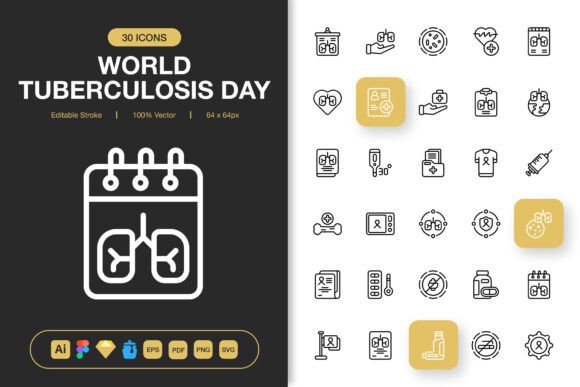
What separates this particular collection from generic icon packs is its combination of thematic clarity and everyday adaptability. The icons are rooted in the visual language of tuberculosis awareness — lungs, respiratory health, medical cross symbols, infection prevention motifs, and community care imagery — yet they function just as effectively in contexts that have nothing to do with TB. A lung icon styled with clean minimal lines, for instance, works equally well for a pulmonology clinic website, a breathing exercise app, or a wellness infographic. This dual-purpose nature makes the set a pragmatic addition to any designer's toolkit.
What the Collection Includes and Why Format Matters
One of the first things professionals look at when evaluating an icon set is the file structure. A collection might look impressive in preview images, but if it arrives in a single format that requires conversion or lacks scalability, the friction can undermine its usefulness. The World Tuberculosis Day Icons package addresses this by delivering source files in Adobe Illustrator format alongside Figma, Sketch, and Iconjar files — covering the primary tools used by UI/UX designers, brand designers, and digital product teams. EPS Version 10 ensures compatibility with older software and print workflows, while the PDF and SVG files provide additional flexibility for web developers and content management systems.
The PNG transparency files deserve particular attention. They are exported at seven distinct resolutions: 32px, 48px, 64px, 96px, 128px, 256px, and 512px. This range eliminates the need to resize assets manually and risk quality loss. A social media manager pulling icons for Instagram posts can grab the 128px version and know it will render crisply. A web developer implementing a favicon or small UI element can reach for the 32px or 48px versions without opening a design tool. Meanwhile, the 512px size handles larger applications like presentation slides, printed flyers, or banner designs. Having these pre-rendered sizes saves real time during production — it is the kind of practical detail that reflects an understanding of how creative work actually gets done.
Editable Stroke and the Minimalist Advantage
Design trends shift, but minimalist icon design has proven remarkably durable. Clean lines, consistent stroke weights, and uncluttered shapes reduce cognitive load for viewers and integrate smoothly into diverse visual environments. The editable stroke feature in this set gives designers control over thickness, color, and style without rebuilding icons from scratch. You can match brand guidelines precisely by adjusting strokes to complement typography choices or interface themes. For a healthcare nonprofit with an established visual identity, this means the icons can slide into existing materials without looking like afterthoughts.
Customization extends beyond stroke editing. Since the source files are vector-based, every icon can be recolored, scaled infinitely, combined with other elements, or deconstructed into component shapes. A designer working on an annual report for a global health organization might extract the core lung symbol, pair it with data visualization elements, and create something entirely original while maintaining visual coherence with the broader icon family. This level of control matters when you need imagery that feels bespoke rather than stock — a subtle but important distinction in professional communication.
Real-World Applications Across Mediums
The stated versatility of the World Tuberculosis Day Icons — suitable for websites, mobile apps, books, social media, infographics, flyers, print, banners, and posters — is not hyperbole. Let us examine how the set performs across several common scenarios.
Website and mobile app interfaces: Icons in this category benefit from the minimalist approach. Navigation elements, feature callouts, and onboarding screens using these icons maintain clarity at small sizes. The consistent visual language across the set prevents the disjointed feel that occurs when designers mix icons from different sources. For telemedicine platforms, health tracking apps, or clinic finder tools, the medical-themed icons serve obvious functional roles, but even general-purpose applications can use the more universal symbols — community, communication, and care icons — without the medical context feeling forced.
Print and publication design: Books, brochures, and printed reports demand high-resolution assets that reproduce cleanly. The vector source files guarantee sharp output at any size, and the included PDF and EPS formats simplify handoff to print vendors. An educational booklet about respiratory health could use the icons as chapter dividers, margin notes, or infographic anchors. Because the style is restrained, the icons complement body text rather than competing with it — a quality that editors and layout designers will appreciate.
Social media and digital marketing: Platforms like Instagram, LinkedIn, and X reward clear visual communication. The World Tuberculosis Day Icons provide ready-made elements for carousel posts, story graphics, and event announcements. A March 24 awareness campaign gains immediate visual cohesion when all posts draw from the same icon family. Beyond TB-specific content, healthcare marketers can repurpose the icons year-round for general wellness messaging, patient education, or staff recruitment materials.
Infographics and data storytelling: Icons serve as powerful visual anchors in data-heavy layouts. Replacing bullet points or generic clip art with purpose-designed symbols elevates the perceived quality of an infographic. The respiratory and health-focused icons in this set naturally complement statistics about lung disease, air quality, infection rates, or healthcare access. Because the icon style is neutral and professional, the graphics support the data rather than distracting from it — a balance that infographic designers constantly seek.
Quality and Consistency: What to Expect in Daily Use
Icon sets can suffer from internal inconsistency — one icon feels heavier than another, spacing varies, or stylistic decisions drift across the collection. Based on the described feature set and the deliberate inclusion of editable stroke properties, the World Tuberculosis Day Icons appear to prioritize uniformity. For a designer, this means confidence that icons placed side by side in a navigation bar or feature grid will feel like they belong together. The grid alignment, stroke weight consistency, and proportional balance are the invisible qualities that separate professional iconography from amateur efforts.
The drag-and-drop ease mentioned in the feature list points to another practical consideration: how quickly can someone incorporate these icons into a workflow? In Figma, for instance, opening the provided file gives immediate access to all icons as components, searchable and insertable without browsing folders. In Illustrator, well-organized layers and artboards reduce the friction of locating the right symbol. For teams moving fast — which describes most creative teams — these organizational details prevent small frustrations from accumulating.
Who Gains the Most from This Icon Set
Several specific audience segments will find the World Tuberculosis Day Icons particularly valuable. Public health communicators and NGO designers working on TB awareness campaigns represent the most obvious user group. For them, the thematic relevance is direct and the March 24 observance date creates predictable annual demand for fresh visual assets. Having a dedicated icon set eliminates the need to commission custom illustrations or repurpose generic medical icons that lack TB-specific imagery.
Healthcare marketers and medical content creators form a second key audience. Private clinics, hospitals, pharmaceutical companies, and health insurance providers all produce substantial volumes of patient-facing content. Icons that communicate respiratory health concepts clearly and professionally support blog posts, email newsletters, patient portals, and waiting room displays. The versatility means the same icon set serves digital and print needs simultaneously — a practical efficiency for organizations managing multiple content channels.
Freelance designers and small studio owners benefit from assets that reduce project time without compromising quality. When a client in the health and wellness space needs icons, pulling from a ready-made, editable set accelerates the design process while maintaining professional standards. The multi-format delivery means the freelancer can work in their preferred software and deliver assets in whatever format the client requires, from SVG for web developers to EPS for print partners.
Educators and academic publishers represent a quieter but significant audience. Lecture slides, textbook diagrams, and research poster presentations all improve with high-quality supporting graphics. The lung anatomy, infection pathways, and community health icons in this set could illustrate concepts in biology, public health, and social medicine courses without the visual clutter that plagues many academic graphics.
Practical Limitations and Considerations
No resource fits every scenario, and acknowledging limitations helps potential users make informed decisions. The most self-evident consideration is thematic scope. While many icons in the set work in general contexts, the core identity ties to tuberculosis and respiratory health. A designer seeking icons for financial services, food delivery, or fashion e-commerce would find only a subset of the collection applicable to their needs. The set works best when health, medicine, community care, or public awareness are relevant to the project — even tangentially.
The minimalist style, while broadly compatible, may not suit brands with highly ornate or illustrative visual identities. If a client's brand guidelines call for hand-drawn, textured, or heavily detailed iconography, the clean lines and geometric precision of this set could feel mismatched. That is not a flaw — it is a stylistic boundary worth recognizing before purchasing or downloading.
Additionally, the editable stroke feature assumes some familiarity with vector editing tools. Beginners opening an Illustrator or Figma file for the first time might need time to learn how to modify strokes, change colors, or export assets correctly. The included Readme.txt file presumably offers guidance, but users entirely new to design software should expect a modest learning curve.
Long-Term Value and Reusability
Creative assets gain or lose value depending on how often they can be reused across projects. The World Tuberculosis Day Icons have a clear annual anchor — World TB Day on March 24 — but their utility extends throughout the year. Respiratory health content, infection prevention messaging, and general medical communications are evergreen needs. An icon set purchased for a specific awareness campaign in March can support blog graphics in June, conference materials in September, and social media content in December. This extended usability changes the value calculation from a single-use expense to a recurring resource.
The multi-format delivery also future-proofs the purchase. As design tools evolve, having source files in widely adopted formats — particularly SVG and the native formats of current industry-standard tools — means the icons remain accessible even if your team's software stack changes. The Iconjar file specifically supports organized icon management, allowing teams to browse, search, and export icons without opening a full design application. For organizations building internal asset libraries, this small addition carries disproportionate practical value.
For professionals evaluating whether this icon set merits a place in their resource library, the decision ultimately hinges on relevance and workflow fit. If your projects intersect with health communication, respiratory medicine, or public awareness campaigns, the combination of thematic specificity, format flexibility, and design quality makes a compelling case. The editable, scalable nature of the assets means they can adapt as brand needs shift, and the minimalist aesthetic resists the rapid dating that affects more stylistically aggressive design trends. These are workhorse graphics — designed not to impress in isolation but to perform reliably across the many contexts where clear, professional visual communication matters.